// Contents
PropBuilds earns a commission if you buy through links on this page, at no extra cost to you.
For most cosplay props, PLA is the best filament: it's the easiest to print, holds fine detail, sands smooth and takes paint well, and it's stiff enough for helmets and armor. Use PLA+ for props you swing or knock around, PETG for props that have to survive heat and bumps, and ASA on an enclosed printer when you need the most heat resistance. Matte PLA hides layer lines, which saves sanding on display pieces.
The deciding question is heat. PLA starts to soften at around 55 to 60 degrees C, and a closed car in summer gets hotter than that, so a PLA helmet left on a back seat can warp. PETG holds out to roughly 75 to 80 degrees C, and Polymaker's listing says its ASA withstands up to 100 degrees C. If your prop will never sit in a hot car or in the sun, PLA is the easy, right answer.
Filament choice matters most for two kinds of prop: things you wear and things you swing. Of the 5,491 print files PropBuilds indexes, 617 are weapons and 433 are helmets or masks.
The picks
The links go to Amazon, where you can check the current price.
| Filament | Best for | Why | Watch out for | A pick |
|---|---|---|---|---|
| PLA | Helmets, armor, display props | Easiest to print; holds detail; sands and paints well | Softens in a hot car | ELEGOO PLA |
| PLA+ | Props you handle, swing or knock | Tougher than plain PLA, prints almost as easily | Same heat limit as PLA | eSUN PLA PRO (PLA+) |
| Matte PLA | Display pieces and helmets | Hides layer lines, so less sanding | Can be a little more brittle | ELEGOO Matte PLA |
| PETG | Props that face heat, bumps or the outdoors | Tougher and more heat resistant than PLA | Strings; harder to sand and glue | ELEGOO PETG |
| ASA | The most heat and sun resistance | Takes more heat than PETG and resists UV | Needs an enclosed printer and fresh air | Polymaker ASA |
PLA: the default for helmets and armor
PLA prints at low temperatures without an enclosure, barely warps, and holds sharp detail. It sands to a smooth finish and takes primer and paint well, which is most of the work on a prop. A plain black 1 kg spool like ELEGOO PLA is fine for helmets, armor plates, emblems and display props. Its weak points are heat and impact: it softens in a hot car and can snap if a thin part is dropped.
PLA+ for props that get handled
PLA+ is PLA blended to be tougher. eSUN PLA PRO (PLA+) is one example; its listing claims it is several times stronger than PLA, recommends a 205 to 225 degrees C nozzle, and says it ships vacuum sealed with a desiccant. It prints almost exactly like PLA, so it's the easy upgrade for blasters, sword hilts, gauntlets and anything that gets bumped at a convention. It has the same heat limit as PLA.
Matte PLA for less sanding
Matte PLA prints with a flat, stone-like surface that hides layer lines. ELEGOO Matte PLA's listing describes nearly invisible layer lines, and asks you to keep the door open if you print it in an enclosed printer. For helmets and display pieces you'll paint, it can save a lot of sanding. It can be a little more brittle than regular PLA, so use regular PLA or PLA+ for thin parts that take knocks.
PETG for heat and bumps
PETG flexes before it breaks and takes more heat than PLA, which makes it the pick for props that travel in cars, go outdoors or get knocked about. ELEGOO PETG's listing highlights its durability and high impact resistance. The trade-offs show up after printing: PETG strings more, sands poorly because it gums up rather than powdering, and is harder to glue, so scuff it well or use epoxy. The joining guide covers glues for each material.
ASA for the most heat and sun resistance
ASA behaves much like ABS, with added weather resistance. Polymaker ASA's listing says it withstands up to 100 degrees C and is UV and weather resistant, and it recommends an enclosed printer for large parts to prevent warping. It gives off fumes while printing, so ventilate the room. Use it for props that live outdoors or in the sun, if you have an enclosed printer like the ones in the printer guide.
Keep it dry
Filament absorbs moisture from the air, and wet filament strings, pops and prints weak layers. PETG, ASA and flexible TPU are the most sensitive. ELEGOO's PETG listing itself says to dry the filament completely before using it again once the bag is opened. A filament dryer like the SUNLU Filament Dryer S2, whose listing gives a maximum temperature of 70 degrees C, fixes it; between prints, store spools in sealed bags with desiccant.
What about resin? For small, highly detailed parts like badges and emblems, a resin printer beats any filament. The resin vs filament guide covers when each one makes sense.
Before you print
Check the scale first: the helmet size calculator works out the scale for your head and whether it fits your printer, and the 3D print cost calculator shows what a print costs in filament and power. After printing, the finishing guide covers sanding and paint.
FAQ
What is the best filament for cosplay?
PLA for most of it: it's the easiest to print, holds detail, and sands and paints well. Use PLA+ for props you handle roughly, PETG for anything that will sit in a hot car or get knocked around outdoors, and ASA on an enclosed printer when you need the most heat resistance.
PLA or PETG for a cosplay helmet?
PLA, unless the helmet will get hot. PLA is easier to print and much easier to sand smooth, which matters on a helmet. PETG survives heat and impacts better, but it strings, sands poorly and is harder to glue, so it's more work to finish.
What is the best filament for cosplay weapons?
PLA+ or PETG, since weapons get swung, dropped and bumped. For long parts like blades and barrels, the filament matters less than the joins: pin the seams, and run a metal rod through long thin parts.
How much filament does a helmet take?
Your slicer shows the exact weight before you print. As a rough guide, a full-size helmet usually takes several hundred grams, so one 1 kg spool covers a helmet with some left over for test prints. The 3D print cost calculator turns the weight into a price.
As an Amazon Associate I earn from qualifying purchases. The Amazon links on this page are affiliate links: check the current price and details on Amazon before you buy.
PropBuilds is a fan-run site, not affiliated with or endorsed by the studios or rights holders of the games mentioned.
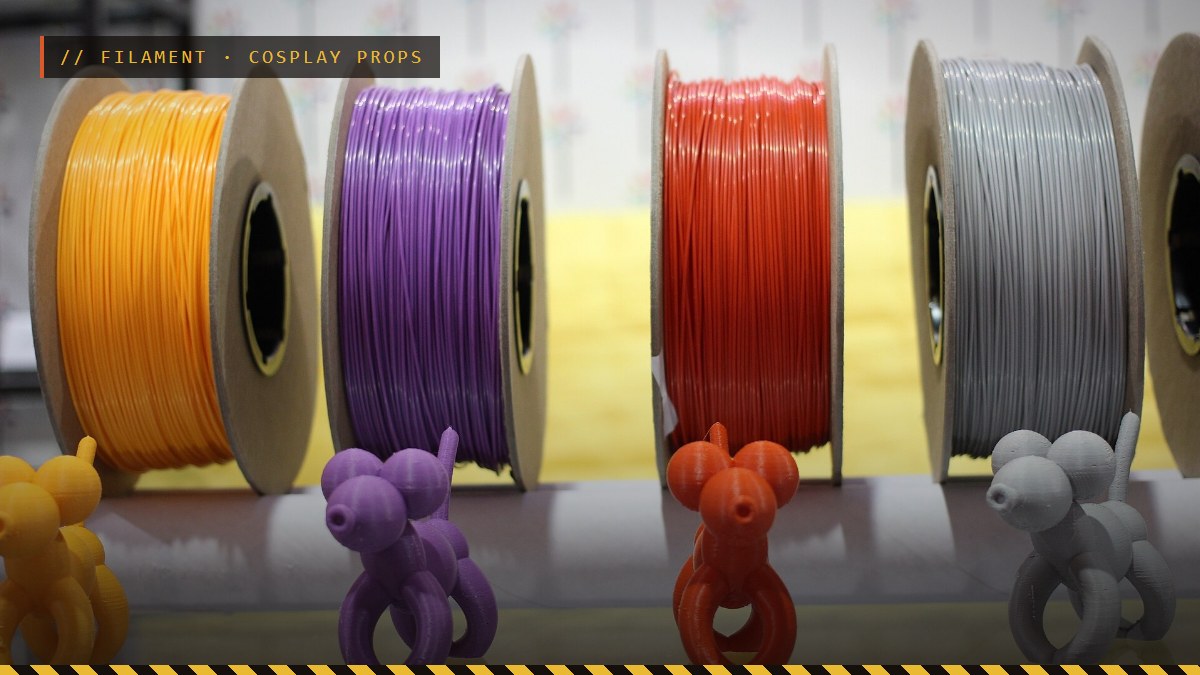
Header photo: 3D Printing Materials by Maurizio Pesce from Milan, Italia on Wikimedia Commons, licensed CC BY 2.0; cropped, with an overlay added.