// Contents
PropBuilds earns a commission if you buy through links on this page, at no extra cost to you.
For cosplay props, use filament for anything you wear or hold: helmets, armor, blasters and swords. A filament printer has a bigger build box, makes tougher parts and needs no chemical cleanup. Use resin for small parts where detail matters most, like badges, insignia, figure heads and tiny greebles. Resin prints far finer detail, but in a smaller box, and liquid resin needs gloves, fresh air and a wash and cure step. Plenty of prop makers end up owning both.
The numbers. A 256 mm filament printer like the Bambu Lab A1 has a 16.8 liter build box. ELEGOO's Saturn 4 Ultra 16K, a large resin printer, has 5.5 liters: about a third. In exchange its pixels are 14 by 19 microns, where a standard filament nozzle lays lines 0.4 mm wide. Big parts go to filament; small, detailed parts go to resin.
Side by side
| Filament (FDM) | Resin (MSLA) | |
|---|---|---|
| Build size | 256 mm cube on a mid-size printer like the A1, P1S or Centauri Carbon | 211.68 x 118.37 x 220 mm on the Saturn 4 Ultra 16K |
| Detail | Visible layer lines; sand and fill for a smooth finish | Very fine detail, with layer lines that are hard to see |
| Strength | PLA and PETG parts take handling and wear well | Standard resin is stiff but brittle: thin parts snap. Tough resins help |
| Cleanup | Pull off supports and sand | Wash in alcohol, cure under UV, then remove supports, all in gloves |
| Safety | Ventilate the room; PLA is the mildest to print | Liquid resin irritates skin and smells: gloves, eye protection, fresh air |
| Best for | Helmets, armor, blasters, swords, anything big | Badges, emblems, small greebles, figures, jewelry-scale props |
Why filament wins for helmets and armor
Size is the first reason. An adult head is roughly 15 cm wide, and a helmet adds padding and a shell on top of that, so a full helmet is wider than the Saturn's 118 mm plate depth in every direction and has to be printed in many pieces. On a 256 mm filament printer, helmet files usually split into a few parts along panel lines; the helmet size calculator tells you the scale for your head and whether it fits your bed.
Toughness is the second. PLA and PETG flex a little before they break, which is what you want in something you wear all day or swing around. Standard resin is stiff and brittle, so a thin fin or a long barrel can snap if it's dropped. Tough and ABS-like resins help, but they cost more and still aren't as forgiving.
And it's cheaper per part. A full helmet often takes several hundred grams of filament; the same volume in resin costs more, and adds cleaning alcohol, gloves and paper towels. The 3D print cost calculator shows what a print costs with your own prices, for filament or resin.
Where resin earns its place
Resin shines on small, detailed parts that are seen up close: rank badges and emblems, holster buttons, small greebles on a blaster, grenade caps, figure heads, rings and pendants. These print with almost no visible layers, so they need far less sanding than the same part in filament. A common workflow is a filament body with resin details glued on.
The picks
The links go to Amazon, where you can check the current price.
- Filament, open frame: the Bambu Lab A1, a 256 mm printer that suits PLA and PETG, the two filaments most props are printed in.
- Filament, enclosed: the Bambu Lab P1S or the ELEGOO Centauri Carbon, the same 256 mm size with an enclosure for heat-resistant filaments like ABS and ASA.
- Filament to start with: a 1 kg spool of PLA, like this ELEGOO PLA.
- Resin printer: the ELEGOO Saturn 4 Ultra 16K. Its listing says it heats the resin tank to 30 degrees C, uses tilt release and prints at up to 150 mm per hour.
- Wash and cure: the ELEGOO Mercury Plus V3.0, whose listing describes a 7.5 L wash tank, 24 UV lights at 405 nm, a cover that blocks 99.9% of UV, and runs of up to 30 minutes.
The printer guide goes deeper on filament printers and bed sizes for props.
Resin safety, plainly
Liquid resin irritates skin and eyes, and repeated skin contact can make you allergic to it, so treat it like a chemical, not a craft paint:
- Wear nitrile gloves whenever you touch liquid resin or uncured prints, and eye protection when you pour.
- Print in a room with fresh air, not a bedroom. Many people who print resin also wear a respirator with organic vapor cartridges, like the 3M 6311 P95 organic vapor respirator.
- Wash prints in alcohol and cure them fully under UV before you handle them bare-handed.
- Keep resin, used alcohol and uncured waste away from kids and pets, and never pour them down a drain: cure waste resin in sunlight and dispose of it the way your local rules say.
- Read the safety data sheet for the resin you buy; it's the final word.
Heat and sun. PLA softens in the heat of a closed car in summer, and many resins yellow and get more brittle with long sun exposure. Primer, paint and a clear coat protect both. The finishing guide covers the full sand, prime and paint process.
So which should you buy?
If you want to wear what you print, buy a filament printer first. It covers helmets, armor and full-size props, and costs less to run. Add a resin printer when you find yourself wanting crisper small details than filament can give. Once a helmet is printed, the helmet padding guide covers making it wearable.
FAQ
Is resin or filament better for cosplay?
Filament, for most of it. Helmets, armor and weapons are big, and a filament printer has a bigger build box, makes tougher parts and needs no chemical cleanup. Resin is better for small parts where detail matters most, like badges, emblems and figure heads.
Is resin more expensive than filament?
Usually, per kilogram, and resin also uses up cleaning alcohol, gloves and paper towels. For a small part the difference is small; for something helmet-sized it adds up fast. The PropBuilds 3D print cost calculator works for both: enter the grams your slicer reports and the price and weight of your spool or bottle.
Is resin 3D printing worth it?
If you want small, highly detailed parts, yes: nothing else you can run at home gets close to its detail. If you mostly want helmets and armor, start with a filament printer and add resin later for the fine parts.
Is resin toxic when cured?
Fully cured resin is much safer to handle than liquid resin, but parts that aren't fully cured can still irritate skin, so wash and cure them completely and wash your hands after handling. Don't use resin prints for food or drink, and follow the safety data sheet for the resin you buy.
As an Amazon Associate I earn from qualifying purchases. The Amazon links on this page are affiliate links: check the current price and details on Amazon before you buy.
PropBuilds is a fan-run site, not affiliated with or endorsed by the studios or rights holders of the games mentioned.
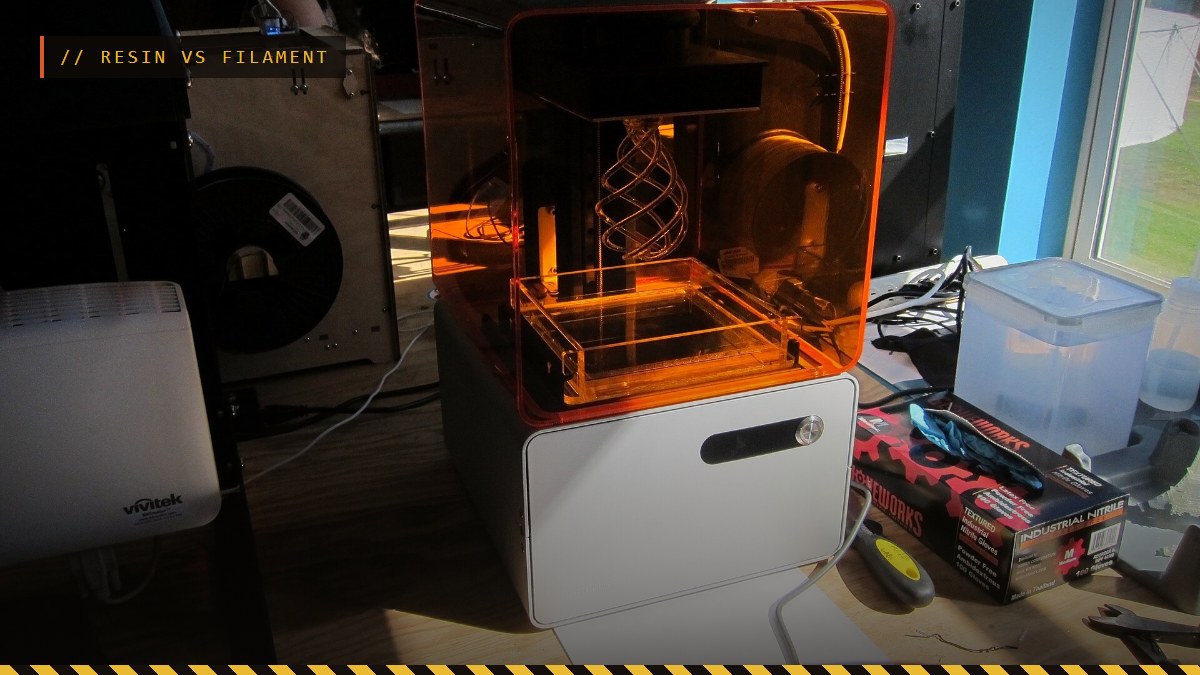
Header photo: Make Magazine 3D Printer Shootout Weekend by John Abella from Outside Philadelphia, USA on Wikimedia Commons, licensed CC BY 2.0; cropped, with an overlay added.